When One Partner Tries Harder: Fixing Uneven Effort Without Nagging
In almost every couple, one person is the one who remembers. Who suggests the walk, who books the thing, who downloads the app and sets it up hopefully. If that's you, you've probably wondered whether your partner cares less than you do. Usually they don't. But the habit you built quietly assumed they'd show up exactly like you do. Here's how to design connection that survives uneven effort, without nagging and without keeping score.
Is it normal for one partner to try harder?
Yes, and it's close to structural. In most couples one person carries the bulk of what researchers call relationship maintenance work: noticing the emotional temperature, initiating check-ins, remembering that you haven't really talked in a week. Sociologists studying households have documented the same asymmetry in the invisible planning work of domestic life. The split is rarely 50/50, and expecting it to be sets you up to feel perpetually shortchanged.
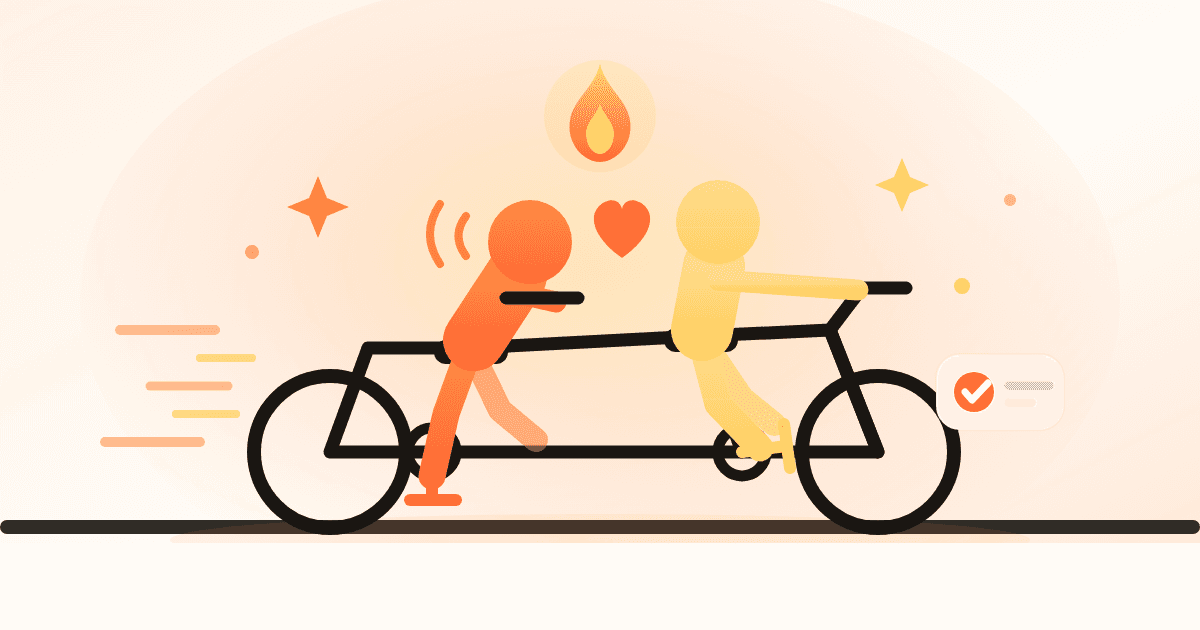
It helps to name the roles without loading them with judgment. Call it driver and passenger. The driver initiates and steers. The passenger comes along, often happily, sometimes obliviously. Both people are in the car; only one is watching the road. That dynamic says very little about who loves whom more. What it describes is a difference in how attention gets allocated, and it shows up in relationships of every configuration.
Uneven effort rarely breaks a couple's habit on its own. The ledger one partner starts keeping does, and so does the audit the other starts feeling.
Why does uneven effort hurt so much?
Because it doesn't stay a logistics problem. Within a few weeks, “I always suggest the walk” quietly becomes “I matter less to them than they matter to me.” That second sentence is the injury. The unequal minutes are almost beside the point; what stings is what the inequality seems to say about your standing. Meanwhile the passenger is usually running a completely different internal script: things seem fine, so why is my partner upset?
Two forces make it worse. The first is the invisible ledger. Once you start counting, you count only your own contributions accurately, because those are the ones you actually experienced. The second is that the driver's frustration usually leaks out as commentary (“you never…”, “I guess I'll do it again”), which lands on the passenger as criticism. Criticism reliably produces defensiveness, and defensiveness reliably produces less effort. The dynamic feeds itself, and it's how drift gets an accelerant.
Why does nagging backfire every single time?
Nagging is a reasonable response to a real problem, and it still doesn't work. Here's the mechanism. A reminder delivered with an edge changes what the habit means. Before, the evening check-in was a small warm thing. After, it's a compliance test with a supervisor attached. Nobody sustains a behavior whose main message is “you are being monitored and you are falling short.”
There's also a timing trap. Nagging tends to arrive precisely when the passenger already feels behind, in the middle of a bad week with no capacity left, so the habit becomes permanently associated with the feeling of failing. The fix has nothing to do with discipline on their side or patience on yours. Lower the cost of participating until effort stops being the bottleneck at all.
Why do couples apps and rituals die when engagement is uneven?
Look at what most relationship tools ask of you: daily prompts to answer thoughtfully, journals to fill in, quizzes to compare, questions to discuss. Every one of those assumes two people with matching enthusiasm and spare attention on the same evening. That's the design flaw. When only one partner has the energy, a two-enthusiast system doesn't degrade gracefully. It just stops, and the driver is left holding an app that now measures their disappointment.
| Design choice | Built for two enthusiasts | Built for uneven effort |
|---|---|---|
| Time cost | A daily prompt to answer thoughtfully (3 to 10 min) | A 2-second tap, doable from the lock screen |
| Who can complete it | Both partners must act, or the day does not count | Either partner can confirm the day for both |
| Scorekeeping | Individual stats, side-by-side comparison | One shared streak, one shared score |
| Missed days | Streak resets, notification implies blame | A miss is noise; the trend is what is shown |
| Setup burden | Both partners onboard, configure, and commit | One partner sets it up; the other just says yes |
The useful question isn't “how do I get my partner to engage more?” Try this one instead: what version of this works when only one of us has energy? Once you design for the less-engaged partner, the habit survives the weeks that would otherwise have killed it. And engagement usually rises, oddly enough, because participating stopped being expensive.
What actually changes the dynamic?
Four rules. They apply whether you're using a paper calendar on the fridge, a shared note, or an app built for this.
- Shrink it to seconds. Not five minutes. Seconds. If your partner participates by tapping once, they'll participate on the days they're exhausted, and those are the days that decide whether a habit survives. The behavior science behind this is blunt: make a behavior easy enough and it stops needing motivation.
- Let either partner complete it for both. This is the single most important structural choice. If the driver can confirm “we did our thing today” and it counts for the couple, the ritual never depends on the passenger having a good day. It also removes the thing that makes rituals feel like homework: the possibility of being the one who broke it.
- Share the credit. One streak for the couple, never two columns to compare. Individual scoreboards manufacture exactly the comparison that poisons this dynamic.
- Drop the guilt signals. No red X for a missed day, no “your partner is waiting” notification, no pointed silence at breakfast. Guilt buys you one day of compliance and costs you the habit.
How do you bring it up without starting a fight?
You still get to say something. The trick is to talk about the feeling and the design, and to leave their character out of it. Three moves:
- Lead with the feeling, not the tally. “I've been feeling like I'm the only one steering us lately, and it's making me sad” invites a response. “You never plan anything” invites a defense lawyer.
- Ask what connection looks like from their side. Plenty of less-engaged partners are expressing care in ways that don't look like initiating: handling the boring logistics, being reliably present, quietly fixing the thing you complained about. Ask before you conclude.
- Make one concrete, tiny ask. Not “try harder.” One specific behavior, small enough to say yes to on the spot: “Would you tap the check-in when you see it? That's the whole thing.”
What this looks like in practice
Ana and Sofia hit the wall at week two of a shared gratitude journal. Sofia works rotating shifts and kept missing the evening prompt. They swapped it for a single end-of-shift tap that either of them can log for both. Fourteen months later it's still running, and Sofia initiates roughly a third of the time, which is a third more than the journal ever got.
Priya and Dan ran the opposite experiment. Priya stopped mentioning the habit entirely for two weeks, no reminders and no sighs, and simply kept it herself, cheerfully. Dan started joining within days, mostly because nothing was at stake anymore. Marcus and Theo needed the structural fix instead. They moved from two personal streaks to one shared streak, and the low-grade competition that had been quietly annoying both of them evaporated.
Different couples, same pattern. Nobody talked their way into equal effort. They changed the design until unequal effort stopped mattering. If you want a menu of habits small enough to survive this treatment, the 25 five-minute habits list is a good place to shop, and the six-step ritual guide covers the setup end to end.
When is uneven effort actually a problem?
Design fixes cover most cases, though not all of them. Consider talking to a couples therapist if you see any of these:
- Your partner declines connection not from busyness but with contempt or dismissal.
- The imbalance spans everything (emotional labor, household work, planning, care) and conversations about it consistently go nowhere.
- One of you has checked out completely: no interest in repair, no response to warmth, no shared future being imagined.
Habits are a powerful tool for the ordinary asymmetry of two busy people. They're not a substitute for professional help when something deeper is going on, and it's worth being honest with yourself about which one you're looking at.
You can see how that plays out across the whole product on the features overview. The asymmetric-engagement design is deliberate, not an afterthought.
Next in this series: once both of you are showing up, the next thing that breaks is motivation. Digital streaks stop feeling like they mean anything. Next up: why streaks break, and the case for real-world reward stakes (“7 days and you owe me dinner”) that give both partners something to actually play for.
Frequently asked questions
Is it normal for one partner to try harder in a relationship?
Yes. In most couples one person is the default initiator of connection: the one who suggests the walk, books the thing, starts the conversation. Researchers describe this as an asymmetry in relationship maintenance work, and it is far more common than an even split. It becomes a problem only when the initiator starts keeping score and the other partner starts feeling audited.
How do I get my partner to put in more effort without nagging?
Stop asking for more effort and start lowering the cost of effort. Make the connection habit so small it takes seconds, let either of you complete it for both, and respond to every contribution with warmth rather than critique. People repeat what feels good and avoid what feels like an inspection. Nagging reliably produces the second.
My partner won’t use a couples app. What should I do?
Do not ask them to adopt a system; ask them to tap one button. Most couples apps fail because they assume two equally enthusiastic users, with daily prompts, journals, and quizzes. Set the habit up yourself, keep their side of it to a 2-second confirmation from the lock screen, and let them opt into more later, or never. One shared streak with one active driver still works.
Does uneven effort mean my partner doesn’t care?
Usually not. Effort is visible; caring often is not. Many less-engaged partners express care in ways that do not look like initiating: practical support, physical presence, reliability. They also tend to carry an invisible fear of doing it wrong. Ask what connection looks like from their side before concluding it is missing.